

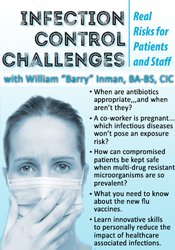
William Barry Inman – Infection Control Challenges
- Faculty:
- William Barry Inman
- Duration:
- 6 Hours 25 Minutes
- Format:
- Audio and Video
- Copyright:
- Apr 25, 2019
Description
Barry Inman, BA-BS, CIC, will share practical solutions to a variety of “what if” infectious disease scenarios that healthcare professionals confront routinely. So many questions can and do arise when it comes to the safety and health of your patients, yourself…and even your family! Are your confident in your responses…
- One patient with an ileal conduit urinary system that, when cultured, revealed microorganisms. Should the treatment include antibiotics…or not?
- A co-worker is pregnant…which patient rooms won’t pose a potential risk?
- What innovative skills can you personally incorporate to reduce the incidence of healthcare-associated infections?
- How can compromised patients be kept safe when multi-drug resistant microorganisms are so prevalent?
- You’ve been providing great patient care all shift. Now it’s time to head home. How do you make that transition and not introduce your family to some of the infectious diseases you’ve been around?
- A disease that may be in a distant part of the world could find its way to our backyard! These emerging cases are often complicated in practice. Are you up-to-date to intervene effectively?
Handouts
| Manual – Infection Control Challenges – Part 1 (26.29 MB) | 191 Pages | Available after Purchase |
| Manual – Infection Control Challenges – Part 2 (48.28 MB) | 198 Pages | Available after Purchase |
| Alaskan Cruise! Set Sail and Save $50 Today (0.63 MB) | Available after Purchase | |
| New York Retreat Get Away! Save $50 (4.75 MB) | Available after Purchase |
Outline
A Summary of Current Recommendations From the CDC, SHEA, IDSA, APIC and the Joint Commission
Health-Care Associated Infections: Strategies to Control-Reduce-Eliminate
- Catheter-Associated Urinary Tract Infections
- Surgical Site Infections
- Ventilator-Associated Pneumonias
- Non-ventilator Associated Infections (overlooked HAI)
- Central-Line Associated Bloodstream Infections
The Latest Multi-Drug Resistant Microorganism Guidelines
- Carbapenem-resistant enterobacteriaceae
- Clostridium difficile
- Methicillin-resistant staphylococcus aureus
- Vancomycin resistant enterococcus
- Acinetobacter baumannii
Influenza
- Avian vs. swine vs. seasonal influenza
- H1N1 pandemic results
- When to treat? When not to treat?
- Treatment with anti-virals and antibiotics
- New vaccines for flu
Vaccination Recommendations for Healthcare Personnel
- Zoster/shingles
- Pneumoccocal
- MMR, Tdap, etc.
Emerging Infectious Diseases (Zoonotic)
- Ebola: What we learned
- Mosquito-borne (“Zika”, Dengue, Chickungunya, West Nile)
- Tick-borne (Lyme and Babesia)
- Cryptosporidiosis
Bloodborne Pathogens
- Hepatitis B
- Vaccination protocol for healthcare personnel
- Staff follow-up after significant exposures
- Treatments for persons chronically infected
- Outbreaks in healthcare
- Hepatitis C
- Treatment “cures” in 12-24 weeks
- Outbreaks in healthcare-dialysis settings
- HIV/AIDS
- New one pill daily treatment
- Healthcare exposure and appropriate prophylaxis
Tuberculosis
- Today’s best approaches to treatment
- Skin testing vs. blood test for exposure
- Follow-up guidelines for healthcare workers conversion testing
Faculty

William Barry Inman, BA-BS, CIC Related seminars and products: 6
William “Barry” Inman, BA-BS, CIC, has 31 years of experience as an epidemiologist. He works for the Brevard County Health Department in Merritt Island, Florida. He is responsible for the development and implementation of surveillance and investigation of all communicable diseases. Additionally, he is a faculty member for Brevard Community College and the University of Central Florida teaching classes on infection control. Barry has completed advanced training in bio-terrorism through the Department of Health in Florida, Center for Disease Control and Prevention, and the United States Army Institute of Research for Infectious Diseases. Barry has also received training in various communicable diseases and disease outbreak investigations.
Because of his extensive experience and education, he has assisted the CDC and Quarantine Service with the investigation of outbreaks on cruise ships for legionella, rubella, measles, norovirus and MRSA. He has done communicable disease investigations in long-term care facilities, hospitals, cruise ships, nursing homes and day-care facilities. Barry has developed infection control programs for hospitals, long-term care facilities, rehab centers, health departments and others. After Hurricane Katrina, he was part of the CDC team that developed an epidemiology/surveillance program for disaster response.
Barry has won numerous awards over the years, including the National Association of County and Community Health Organizations (NACCHO) award for Cruise Ship Investigation and Mitigation of measles, varicella, and rubella. He also won a NACCHO award for “Super Hands”, a hand washing video developed for the control of communicable diseases. Barry also writes a quarterly article for the AMA Journal on various infectious diseases.
Speaker Disclosures:
Financial: William B. Inman has an employment relationship with Brevard County Health Department. He receives a speaking honorarium from PESI, Inc.
Nonfinancial: William B. Inman has no relevant nonfinancial relationship to disclose.
William Barry Inman – Infection Control Challenges
Confront Today’s Infection Threats with Confidence, Competence, and Clinical Precision
Infection Control Challenges, led by William Barry Inman, is a comprehensive, clinician-centered program designed to equip healthcare professionals with advanced tools and updated strategies for navigating modern infection control threats across diverse medical environments.
This course doesn’t just cover the basics—it critically examines emerging pathogens, evolving standards, and real-world complications that demand adaptive, informed, and proactive responses from those on the front lines of care.
Whether you’re working in acute care, long-term facilities, ambulatory settings, or specialty clinics, this program is your guide to developing and applying infection prevention protocols that are not only compliant—but truly effective.
What You’ll Learn Inside Infection Control Challenges
Built on the latest evidence, this course blends clinical insight, regulatory awareness, and practical solutions into one streamlined experience. Key learning outcomes include:
Advanced Understanding of Infection Transmission Pathways
Unpack how healthcare-associated infections (HAIs) are spread—and how to effectively intervene in diverse, high-risk environments.
Guidance on Managing Multidrug-Resistant Organisms (MDROs)
Explore up-to-date protocols for managing resistant infections, including MRSA, VRE, and CRE, with clinical and facility-level strategies.
Environmental and Equipment-Based Containment Measures
Learn how to evaluate and enforce sterilization, disinfection, and environmental hygiene standards that reduce transmission risk.
Behavioral Compliance & Culture Change
Understand how human behavior influences infection outcomes, and how to foster compliance among teams using behavioral science-informed tactics.
Outbreak Response & Emergency Protocols
Prepare for worst-case scenarios with structured approaches to containment, documentation, and cross-departmental coordination.
Legal, Ethical, and Regulatory Considerations
Gain clarity on infection control responsibilities as they relate to licensure, liability, and organizational policies—essential for maintaining institutional integrity.
Who This Course Is Best Suited For
This course was designed to support professionals committed to reducing infection risks across all healthcare settings, including:
-
Infection Prevention Specialists & Compliance Officers
-
Nurses and Clinicians in inpatient or outpatient care
-
Public Health Workers & Epidemiology Teams
-
Healthcare Administrators & Risk Managers
-
Environmental Services Leaders & Unit Managers
Whether you’re refining an existing infection control plan or implementing one from the ground up, this course offers the evidence-backed framework and critical thinking strategies to elevate your impact.
About William Barry Inman
William Barry Inman is a seasoned healthcare educator with a distinguished background in infection control policy, public health infrastructure, and clinical education. With decades of experience in designing and delivering high-stakes training to healthcare professionals, his instruction style balances academic rigor with practical relevance. Known for his clarity, depth, and focus on real-world applicability, Barry empowers providers to act decisively and think systemically in the face of infectious threats.
Why This Course Matters Now More Than Ever
-
Up-to-Date and Future-Ready: Reflects the latest CDC, WHO, and local health authority guidelines—plus forward-looking practices for next-gen threats
-
Cross-Disciplinary: Equally relevant for clinicians, administrators, and support personnel
-
Designed for Immediate Application: Structured to help learners implement what they learn right away
-
Addresses Both Human and Environmental Risk: Tackles infection control from a truly holistic perspective
Protect Your Patients. Empower Your Teams. Elevate Clinical Safety Standards.
In today’s rapidly evolving healthcare landscape, infection control isn’t optional—it’s foundational. Infection Control Challenges equips you to meet today’s risks with tomorrow’s solutions.
→ Enroll today and become a proactive force for safety and resilience in your organization.





Reviews
There are no reviews yet.